
%20(1).webp)
Writing copy for your business website can take a lot of time and effort, especially when your goal is high conversions, not just good-sounding text. From headlines and subheadings to testimonials, layouts, and design alignment, a single service page can easily become weeks of back-and-forth. But with tools like ChatGPT, you can significantly speed up this process without compromising on quality, strategy, or brand alignment.
In this article, I’ll walk you through exactly how to write a service page copy with ChatGPT, using a real project, a real website template, and a real workflow, step by step. If you prefer learning visually, you can watch the complete practical walkthrough in the video below:
Table of Contents:
Why Service Page Copy Matters
How to Write a Service Page Copy with ChatGPT: Step-by-Step Process
Use a Document to Organize Your Copy
Focus on Progress, Not Perfection
Improve Headlines and Sub-Headlines with These Free Resources
Frequently Asked Questions
Conclusion
Why Service Page Copy Matters
A service page is one of the most critical pages on a business website. It explains what you offer, who it’s for, and why someone should choose you over competitors.
A well-written service page should:
- Clearly explain your service
- Highlight the benefits and value proposition
- Showcase proof, such as testimonials
- Guide visitors toward a conversion action
However, writing all of this from scratch can be time-consuming. This is where ChatGPT becomes extremely helpful.
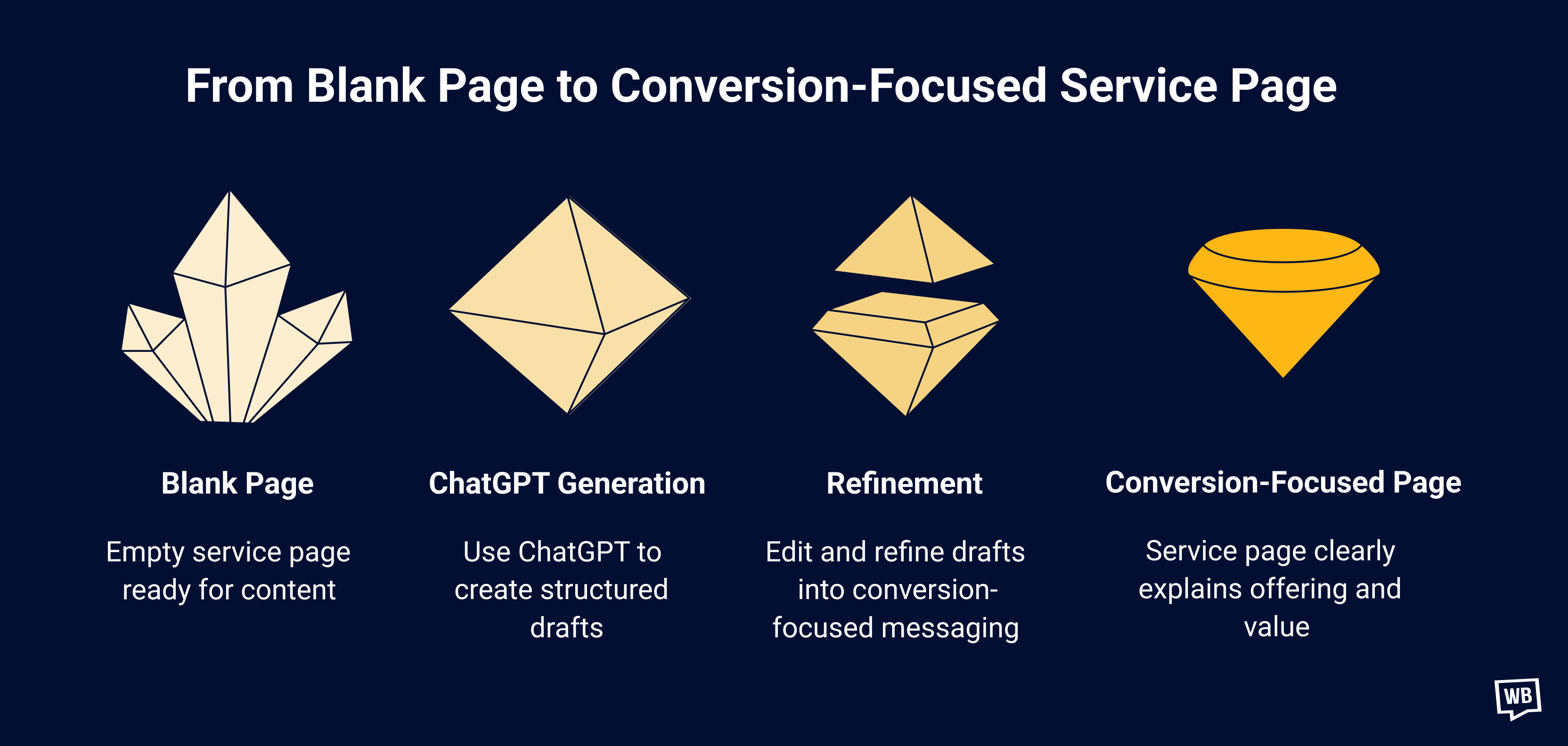
Instead of staring at a blank page, you can use it to generate structured drafts and refine them into conversion-focused messaging.
How to Write Service Page Copy with ChatGPT (Step-by-Step)
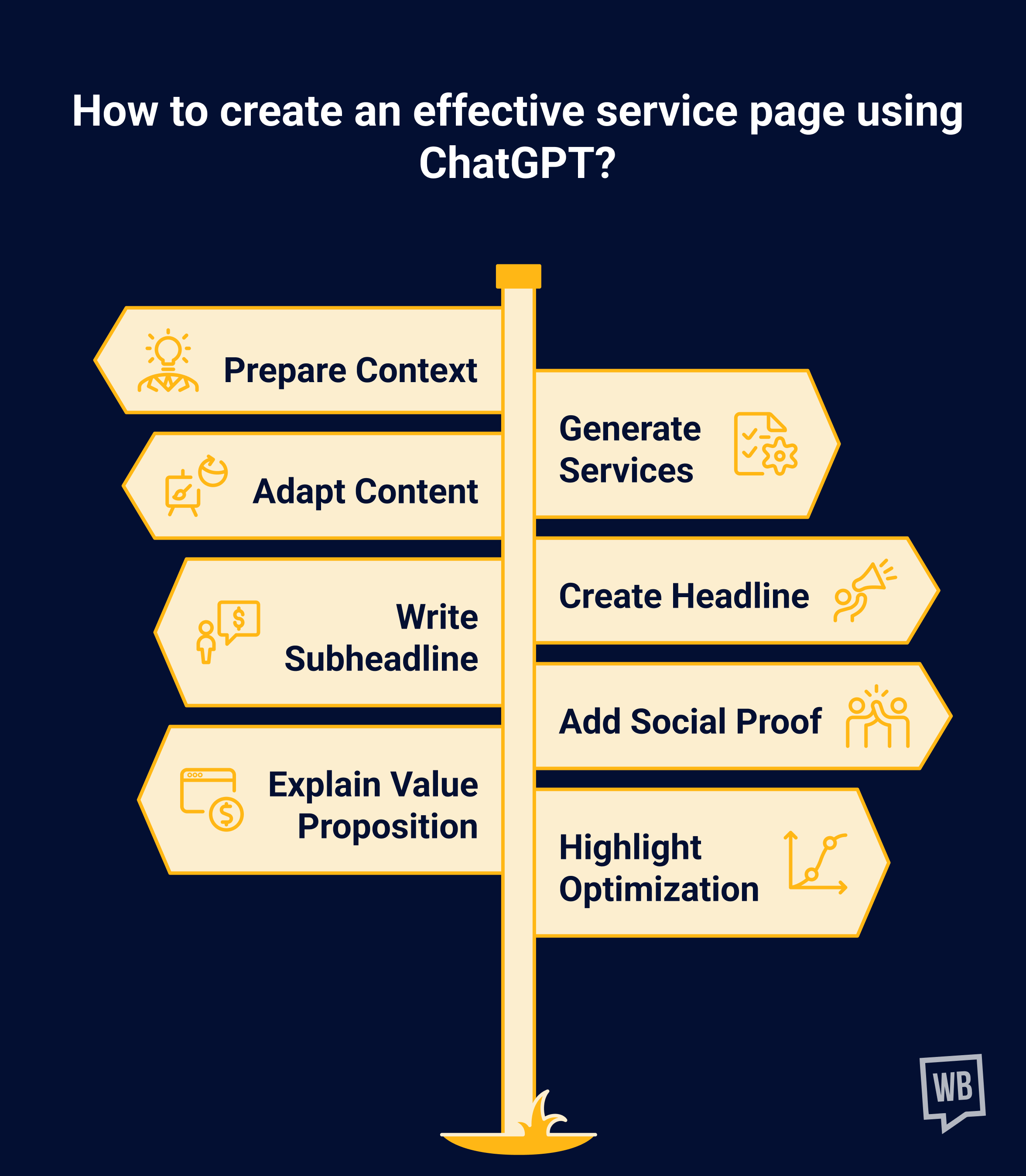
Creating a service page using AI works best when you follow a structured workflow. The process involves preparing context, generating ideas, adapting content to your design, and refining it for clarity and conversions.
1. Start With Your Brand Context
The biggest mistake people make when learning how to write service page copy with ChatGPT is starting with a generic prompt like "Write a service page for a web designer." This results in bland, "robotic" copy.
To get professional results, you must first "prime" the model. Before asking for a single headline, ensure ChatGPT has access to:
- Your Mission Statement: What does your brand stand for?
- Core Value Propositions: Why should someone choose you over a competitor?
- Client Testimonials: Real feedback from your customers provides the "social proof" language that AI can mimic.
- Brand Voice Guidelines: Is your tone professional, witty, or aggressive?
Uploading or pasting this information into ChatGPT allows it to understand your business and generate content that aligns with your brand.
Instead of producing generic copy, the AI can now tailor its suggestions to your specific business.
2. Ask ChatGPT to Suggest Services
Once the context is loaded, the next step is to ask ChatGPT to suggest possible services for the page.
For instance, if you run a web agency, ChatGPT might suggest:
- Conversion Optimized Website Design
- Landing Page Optimization
- Conversion Rate Optimization (CRO)
- Ongoing Website Maintenance
Pro Tip: Filter these suggestions. If your main agency handles landing pages but your new project focuses specifically on full website builds, instruct the ChatGPT to narrow its focus. This ensures your service pages don't overlap or compete with your other business entities.
3. Expand Each Service Into Structured Copy
ChatGPT expanded the service in a structured way, but that doesn’t mean the copy could be pasted directly onto the site.
Why?
Because:
- The website was built using a template
- The template had character limits
- Certain sections required very specific formatting
This is where most people go wrong with AI.
Instead of forcing the design to fit the copy, the copy was adapted to fit the design.
4. Adapt the Copy to Your Website Template
Most websites are built using templates rather than completely custom layouts.
If you're working with a design system or template (for example, in Webflow), the structure of the page will already be defined:
- How long headlines should be
- Where testimonials appear
- Which sections require short blurbs
- How many words each block allows
This means the AI-generated copy must be adapted to the layout.
For example:
- A headline might need 6–8 words
- A subheading might allow 20 words
- A section description may need 2–3 short sentences
Understanding these constraints helps you prompt ChatGPT more effectively.
5. Generate a High-Impact Headline
The headline is the first thing visitors see on a service page.
To create one using ChatGPT, you can request multiple variations within a specific word limit.
Examples might include:
- Websites built to drive conversions
- Transforming web traffic into tangible growth
- Designing websites that deliver results
- Create websites that convert and grow
A small tweak can make the messaging stronger.
For example:
“We create websites that convert and grow.”
This version feels more confident and action-driven.
6. Write a Supporting Subheadline
The subheadline expands on the headline and reinforces the value proposition.
For instance:
Designed to turn visitors into leads and grow your business consistently.
The goal is to:
- Clarify the promise
- Highlight outcomes
- Maintain concise messaging
ChatGPT can generate several options, allowing you to choose the strongest one.
7. Add Social Proof Using Testimonials
Social proof is essential for service pages because it builds trust.
If you already have testimonials, you can upload them to ChatGPT and ask it to generate short highlight blurbs.
Examples may include:
- “Boosted our conversion rates beyond expectations.”
- “Turned our traffic into consistent leads.”
- “Exceeded expectations and delivered real results.”
These short statements can be placed near the top of the page to reinforce credibility.
8. Create a Strong Section Headline
After the introduction, the page should reinforce your unique positioning.
A powerful example headline might be:
Beyond templates, we deliver growth.
This communicates that your service is not just about design; it focuses on business outcomes.
Strong positioning like this helps differentiate your offering from generic website builders or template-based services.
9. Explain the Core Value Proposition
Next, explain what makes your service valuable.
For example: Conversion-focused websites that boost your bottom line.
Supporting description: Your website should do more than look attractive. It should engage visitors, guide them through the buying journey, and convert them into leads or customers.
Well-designed websites turn traffic into measurable business growth.
10. Highlight Data-Driven Optimization
Another strong section can focus on ongoing performance improvements.
Example headline: Data-driven websites for consistent conversion growth
Supporting copy: Your website should never remain static. By analyzing user behavior and real-time data, you can continuously refine the experience, improve conversion rates, and drive long-term business growth.
This messaging emphasizes that the service is strategic rather than purely visual.
Use a Document to Organize Your Copy
Before sending the content to developers or designers, it helps to organize everything in a structured document.
A common approach is to create a document with:
- Headings for each section
- Notes explaining where each element appears
- Screenshots of the template layout
For example:
- Headline section
- Subheadline section
- Testimonial blurbs
- Process steps
- Supporting content
This ensures the developer understands exactly where each piece of copy belongs.
Focus on Progress, Not Perfection
One important principle when building a new website is to prioritize momentum.
It’s easy to get stuck trying to perfect every line of copy. Instead, the goal should be to create a minimum viable version of the service page.
Once the page is live, you can improve it over time by:
- Refining messaging
- Adding new testimonials
- Improving conversion elements
- Testing different headlines
ChatGPT makes this iterative improvement process much faster.
Improve Headlines and Sub-Headlines with These Free Resources
Strong headlines and sub-headlines play a critical role in the success of any service page. They capture attention, communicate value quickly, and encourage visitors to continue reading.
If you want to generate better messaging with AI, these two resources can help:
ChatGPT Prompts for Sub-Headlines
This guide provides practical prompts you can use with ChatGPT to create clear, benefit-driven sub-headlines that support your main message and guide readers through your page.
https://www.waseembashir.com/chatgpt-prompts-for-sub-headlines
Proven Headline Frameworks
Great headlines often follow proven structures. This resource shares headline frameworks that help you craft attention-grabbing headlines for service pages, landing pages, and blog posts.
https://www.waseembashir.com/headline-frameworks
If you want more ideas for creating strong headlines with AI, you can also explore these best ChatGPT headlines prompts.
Frequently Asked Questions
Q.1: What is the most important element of a service page?
The most important element is a clear value proposition. Visitors should quickly understand what the service is, who it’s for, and why it is valuable.
Q.2: What information should I give ChatGPT before writing a service page?
To get better results, provide details such as your mission statement, core value propositions, brand voice, target audience, and client testimonials. This context helps ChatGPT generate content that aligns with your business rather than producing generic copy.
Q.3: Can ChatGPT help rewrite existing service page copy?
Yes, ChatGPT can be used to improve existing content. You can paste your current copy and ask it to make the messaging clearer, more concise, or more focused on benefits and outcomes.
Q.4: Should service page copy match the website design?
Yes, service page copy should always align with the design and layout of your website. If you're using a template, the content should be adjusted to fit character limits, section sizes, and the overall page structure.
Q.5: What is the biggest mistake when using ChatGPT for website copy?
The most common mistake is using vague prompts without providing context. When you include details about your brand, services, and audience, ChatGPT can produce much more relevant and persuasive content.
Q.6: Can AI-generated copy rank well in search engines?
Yes, AI-assisted content can rank well when it is edited, structured, and aligned with user intent. Search engines prioritize helpful, original, and well-organized content rather than how it was created.
Conclusion
Learning how to write a service page copy with ChatGPT can dramatically simplify the process of building high-converting website pages.
By combining AI assistance with strategic thinking, you can:
- Generate headlines and subheadlines quickly
- Structure service pages effectively
- Incorporate testimonials and proof
- Explain your process clearly
- Launch pages faster and improve them over time
The key is to treat ChatGPT as a collaborative writing partner rather than a replacement for strategy. Provide the right context, refine the outputs, and align the content with your design and brand messaging.
With the right workflow, you can create powerful service pages that not only look great but also drive real business results.
Related Articles:
Blog Writing for Business
Content Marketing Best Practices
How to Create Original Content
SaaS Website Best Practices
B2B Website Best Practices
How To Improve Your Website to Generate Leads
How Can You Ensure Your Content Drives Action
The Importance of Authoritative Content
How Content Marketing Drives Sales


