
%20(1).webp)
For years, businesses believed artificial intelligence was only for companies with massive budgets, elite engineers, and millions of users. That belief is now the biggest barrier to growth.
The real problem isn’t access to AI. It’s knowing how AI could empower any business in a practical, results-driven way.
I’ve seen small businesses waste months trying to “implement AI” with no results, while others quietly increase revenue, reduce costs, and scale faster, using the same tools. The difference is not technology. It’s a strategy.
Think of AI today the way society once viewed literacy. A few hundred years ago, reading and writing were reserved for a select group. Most people had to rely on others to understand knowledge. Then literacy spread, and everything changed.
We are at the same turning point with AI.
AI is not just an upgrade in technology. It is a change in how businesses operate, make decisions, and grow.
The AI Execution Gap: Why Most Businesses Fail
There’s a growing divide in the market. Not between businesses that have AI and those that don’t, but between those who use it effectively and those who don’t.
Most companies start with tools. They try different platforms, expect fast results, and stop when they don’t see immediate impact.
High-performing businesses do the opposite. They start with a clear business problem, apply AI to solve it, measure outcomes, and scale what works, similar to how structured frameworks are used in What is B2B Data-Driven Marketing And How You Can Use It?
This gap is not technical. It is strategic, and it directly impacts how AI could empower any business in real-world scenarios.
Research from McKinsey & Company shows that while AI adoption is rising quickly, only a small percentage of companies manage to scale AI across multiple functions. Most remain stuck in pilot stages and can’t turn their experiments into measurable business value.
That’s the execution gap.
What AI Empowerment Really Means in Business

AI empowerment is often misunderstood as automation or cost-cutting. In reality, it is about enhancing a company’s ability to think, act, and grow with precision.
When implemented correctly, AI transforms scattered data into clear decisions, reduces execution time dramatically, and allows businesses to scale output without proportionally increasing resources. This is the core of how AI could empower any business beyond just efficiency gains.
From a strategic lens, AI gives businesses something extremely valuable: clarity at speed. Instead of reacting to problems after they occur, companies begin predicting and preventing them, similar to how intent-based strategies work.
How AI Transforms Core Business Functions
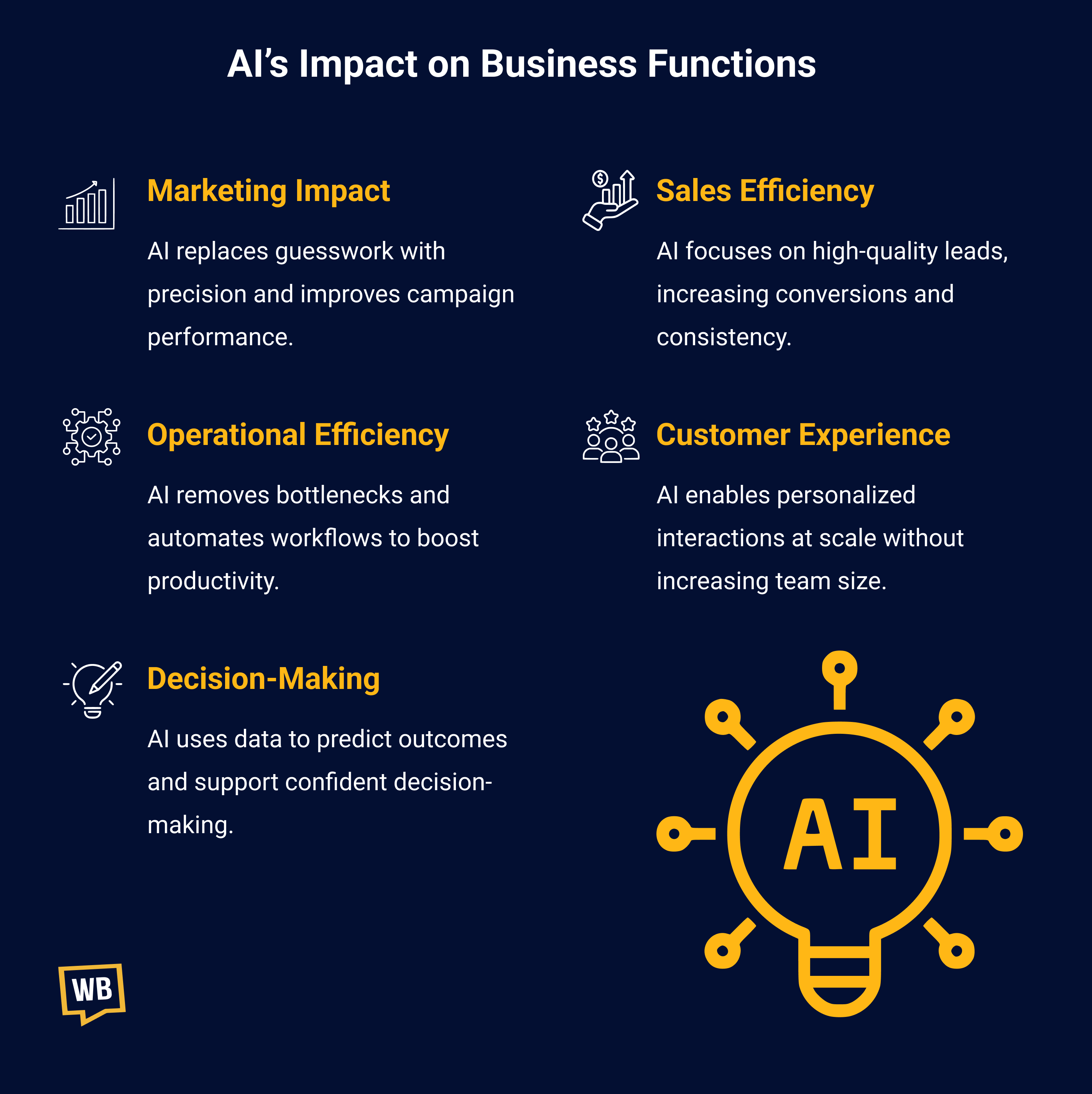
1. Marketing: Turning Attention Into Revenue
Most marketing teams operate on assumptions. AI replaces that with precision.
Instead of guessing what content works, AI identifies patterns in engagement, predicts user behavior, and optimizes campaigns in real time. Businesses that integrate AI into their marketing workflows often see immediate improvements, not because they do more, but because they do what works.
From my experience, the biggest shift happens when businesses stop creating content for everyone and start targeting the right people at the right time.
2. Sales: From Lead Volume to Lead Quality
Sales inefficiency is one of the highest hidden costs in business.
AI changes how pipelines are managed by identifying which leads are most likely to convert. This eliminates wasted effort and allows sales teams to focus on high-value opportunities.
The result is not just better conversion rates, but more consistent performance.
3. Operations: Removing Invisible Bottlenecks
Operations rarely get attention until something breaks. AI prevents that.
By analyzing workflows and identifying inefficiencies, AI helps businesses streamline processes and allocate resources more effectively. What used to require constant monitoring becomes a system that self-corrects.
In one case I worked on, simply automating reporting and forecasting reduced operational workload by over 70%. The team didn’t grow, but their output did.
4. Customer Experience: Scaling Personalization
Customers no longer compare you to competitors. They compare you to the best experience they’ve ever had.
AI enables businesses to deliver personalized interactions at scale. Whether it’s through intelligent chat systems or behavior-based recommendations, companies can respond faster and more accurately without increasing headcount.
This is where AI often delivers the fastest return on investment.
5. Decision-Making: From Guesswork to Predictability
Perhaps the most powerful application of AI is in decision-making.
Instead of relying on historical reports, businesses can use AI to forecast outcomes, simulate scenarios, and make informed decisions in real time. This reduces risk and increases confidence at every level of the organization.
Real Case Studies: AI in Action
The impact of AI becomes clearer when you look at real implementations.
1. Grammarly
Grammarly had no shortage of users, but turning those users into paying customers was a persistent challenge. The company was sitting on massive behavioral data, how users interacted with features, how often they engaged, and what triggered upgrades, but their traditional lead scoring models couldn’t extract meaningful patterns from this complexity. As a result, their sales and marketing teams lacked clarity on which users were most likely to convert.
To solve this, Grammarly implemented Salesforce Einstein, embedding AI directly into its CRM workflows. The system analyzed user behavior in real time, identifying high-intent signals such as feature engagement, session frequency, and upgrade triggers. Instead of static scoring, leads were dynamically ranked based on their probability to convert.
The impact was immediate and measurable. Grammarly saw an 80% increase in paid conversions and a significant improvement in marketing-qualified lead efficiency. Even more importantly, the sales cycle shortened dramatically, from nearly three months to about one month, because teams were no longer wasting time on low-intent prospects.
The real takeaway here is not just improved efficiency, but improved focus. AI didn’t create demand; it revealed where demand already existed and helped the team act faster.
2. Salesforce
Many organizations struggle to extract value from their CRM systems because they rely heavily on manual inputs and reactive decision-making. Salesforce recognized this limitation early and introduced Einstein AI as an intelligence layer across its entire ecosystem.
Einstein processes vast volumes of CRM data, including customer interactions, sales activities, and historical outcomes. It continuously learns from this data to predict customer behavior, recommend next actions, and automate repetitive workflows. What makes this powerful is not just the technology, but its integration; users don’t need to “use AI separately.” It works inside the tools they already rely on.
Today, Salesforce Einstein delivers more than 80 billion AI-driven predictions every single day. Businesses using the platform have reported up to a 32% increase in lead conversion rates, along with improvements in personalization and operational efficiency.
This case highlights a critical shift in how AI creates value. The biggest wins don’t come from isolated tools, but from deeply embedding AI into everyday business processes.
How to Start Using AI Without Overcomplicating It
Most businesses hesitate because they believe AI implementation is complex. In reality, the biggest challenge is not technology—it is clarity.
The process begins by identifying where time is being wasted or where opportunities are being missed. From there, the focus should be on one high-impact area, such as marketing automation or customer support.
Once a simple solution is implemented, the key is to measure results quickly. Early wins build confidence and create momentum for broader adoption.
Training teams is equally important. AI tools are only effective when people understand how to use them and trust their outputs. Businesses that invest in adoption consistently outperform those that only invest in tools.
Common Mistakes That Slow Down AI Adoption
One of the most common mistakes is trying to implement too many AI solutions at once. This creates confusion and dilutes impact.
Another issue is poor data quality. AI systems rely on accurate information, and flawed data leads to unreliable outcomes.
Some businesses also rush into automation without considering the customer experience. While efficiency improves, the quality of interactions may decline if not managed carefully.
Finally, there is the mistake of treating AI as a standalone initiative rather than aligning it with core business goals. Without strategic alignment, even the best tools fail to deliver meaningful results.
The Future of AI in Business
AI is moving from a competitive advantage to an operational necessity.
In the coming years, businesses that fail to adopt AI strategically will struggle to compete, not because they lack resources, but because they lack efficiency and insight.
At the same time, businesses that embrace AI will operate differently. They will make faster decisions, adapt more quickly, and scale without the traditional constraints of time and cost.
Frequently Asked Questions
1. What are the challenges of implementing AI in business?
The biggest challenge is not AI itself, but execution. Most companies lack a clear strategy, struggle with poor-quality data, and don’t have the right skills or internal alignment. Even research shows issues like data accuracy concerns, limited expertise, and privacy risks slow adoption.
2. How does AI improve customer service in businesses?
AI makes customer service faster and more relevant. Instead of waiting for support, customers get instant, personalized responses, which improves both experience and efficiency.
3. What industries can benefit from AI?
AI isn’t limited to one industry. Any business that deals with customers, data, or repetitive work, whether it’s SaaS, retail, healthcare, or finance, can benefit from it.
4. How do small businesses use AI?
Small businesses use AI in simple, focused ways. They automate tasks like marketing, lead follow-ups, or support, which helps them save time and grow without hiring more people
5. What is the 10-20-70 rule for AI?
The rule states that 10% of success comes from AI technology, 20% from data, and 70% from people, processes, and strategy, highlighting that execution matters more than tools.
6. What is the 30% rule in AI?
The 30% rule suggests AI can automate or improve roughly one-third of tasks in most roles. It doesn’t replace jobs; it enhances productivity and frees teams to focus on higher-value work.
7. Do businesses need technical expertise to use AI?
No, most modern AI tools are designed for non-technical users. Businesses can start with user-friendly platforms for marketing automation, analytics, or customer engagement and gradually scale their usage as they gain confidence.
Final Thoughts: Strategy First, Tools Second
AI has the potential to transform any business, but only when applied with intention.
The real advantage comes from understanding where AI can create the most impact and executing with discipline. Businesses that approach AI strategically will not only improve efficiency, but they will also unlock entirely new levels of growth.
In the end, AI is not the differentiator.
How you use it and how AI could empower any business are what truly matter.
Related Articles:
AI Tools for Business Analysts
Best Value AI Website Builder for Beginners
Primary Advantage of Generative AI in Content Creation


