
%20(1).webp)
Sales and marketing alignment is the process of unifying both teams around shared revenue ownership, lead definitions, data, and accountability.
When alignment is missing, marketing generates leads sales can’t use, sales struggles to close, and leadership watches revenue leak from the pipeline.
“Marketing isn’t sending quality leads.”
“Sales can’t close fast enough.”
Sound familiar?
On paper, alignment should be easy. Same company. Same product. Same revenue goals. In reality, sales and marketing often operate like rival teams. The result is stalled growth and lost revenue.
More than half of B2B organisations report losing pipeline and revenue due to poor sales and marketing alignment.
This guide explains:
What sales and marketing alignment actually means
Why misalignment happens
How to fix it using clear systems and proven frameworks
No buzzwords. No vanity metrics. Just alignment that drives revenue.
What Does It Mean to Align Sales and Marketing?

Sales and marketing alignment means both teams share ownership of revenue by using the same goals, lead definitions, data, and accountability systems.
When sales and marketing are aligned, they operate as one revenue engine instead of two separate departments.
Aligned sales and marketing teams:
- Target the same ideal customer profile (ICP)
- Agree on what qualifies a lead at every stage
- Share customer insights, objections, and feedback
- Work toward the same revenue targets
- Are measured on outcomes, not activity
Alignment does not mean sales reports to marketing or marketing reports to sales. It means both teams are accountable to the same revenue outcomes.
According to Harvard Business Review, aligned organisations are those where sales and marketing “share common metrics, systems, and incentives,” rather than operating in silos.
When alignment works, customers experience continuity rather than confusion throughout the buying journey.
Why Does Sales and Marketing Misalignment Happen?
Sales and marketing misalignment happens when teams grow independently with different metrics, tools, and feedback loops.
Misalignment rarely happens because teams are incompetent. It happens because they grow separately.
1. Different Metrics, Same Pressure
Marketing is measured on traffic, MQLs, and engagement.
Sales is measured on pipeline, deals, and revenue.
Both teams feel pressure, but optimise for different outcomes.
2. Poor Lead Definitions
Marketing says, “This is a lead.”
Sales says, “This is a form fill.”
Without shared qualification criteria, frustration is inevitable.
3. Broken Feedback Loops
Sales speaks to buyers daily. Marketing often never hears those conversations. Messaging becomes guesswork.
4. Data and Tool Silos
CRMs, marketing automation, analytics tools, when data lives in separate systems, teams stay disconnected.
5. Marketing Treated as a Support Function
Marketing is often viewed as a “lead factory” instead of a revenue-driving function responsible for pipeline acceleration, expansion, and retention.
Why Is Sales and Marketing Alignment Critical Today?
Sales and marketing alignment is critical because modern B2B buyers complete most of their journey before speaking to sales, making consistent messaging and trust essential for conversion.
That means:
- Marketing influences revenue far beyond lead generation
- Sales relies heavily on trust, positioning, and education created earlier
Without alignment:
- Buyers receive inconsistent messaging
- Sales cycles slow down
- Win rates drop
- Revenue becomes unpredictable
Companies that successfully align sales and marketing consistently achieve:
- Faster sales cycles
- Higher conversion rates
- Better customer experience
- More predictable revenue
How Does Marketing Support Sales When Aligned?
When aligned, marketing supports sales by shaping demand, building trust before first contact, and accelerating deal velocity through education and enablement.
Key contributions include:
- Market research & buyer insights to shape sales conversations
- Demand generation & lead nurturing so sales speak to the right buyers
- Brand positioning & messaging to build trust before the first call
- Sales enablement content that addresses real objections
- Digital presence & social proof that supports deal velocity
When marketing understands actual sales objections and buyer pain points, lead quality improves naturally.
What Sales Does for Marketing
Sales is marketing’s most valuable source of intelligence.
Sales helps align sales and marketing by sharing:
- Real buyer objections and decision drivers
- Feedback on lead quality
- Content validation and improvement
- Competitive insights
- Buying behaviour and timing signals
When feedback loops between sales and marketing are strong, messaging becomes sharper, campaigns become more relevant, and content performs better across the funnel.
How Do You Align Sales and Marketing Step by Step?
Sales and marketing alignment is built through ownership, shared definitions, and enforceable systems, not meetings.
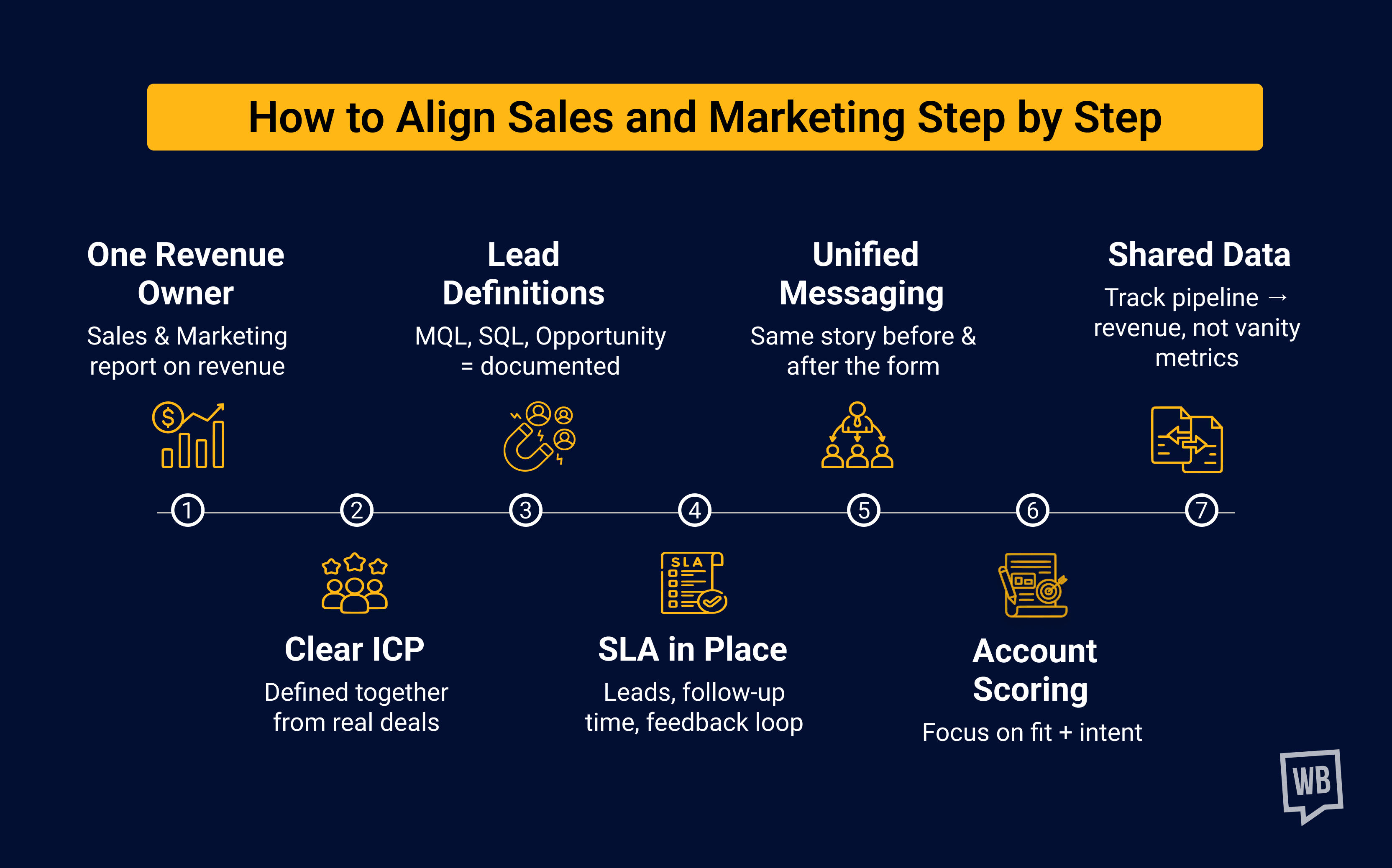
Step 1: Assign One Revenue Owner
The first step in aligning sales and marketing is assigning one clear revenue owner. This fixes half the problem.
Assign one person (Founder, CRO, Head of Growth) to own revenue.
Both sales and marketing report to this role on revenue, not leads.
Weekly reviews focus on:
- Pipeline
- Conversion
- Revenue
This eliminates excuses and speeds up decision-making.
Step 2: Create a One-Page Ideal Customer Profile (ICP)
Sales and marketing must define the ICP together.
Build it using:
- Closed-won deals
- Lost deals
- Sales call insights
- Customer success feedback
When both teams agree on who they want to sell to, lead quality improves automatically.
Step 3: Define What a Qualified Lead Actually Means
This step alone resolves most conflicts.
Define clearly:
- MQL: Fits ICP + shows intent
- SQL: Accepted by sales
- Opportunity: Real buying conversation
Document it. Share it. Review quarterly.
No assumptions. No emotions. Just criteria.
Step 4: Build a Sales & Marketing SLA
An SLA creates clarity, not bureaucracy.
Your SLA should define:
- How many leads does marketing delivers
- How fast do sales follow up
- How feedback flows back
Example:
- Marketing delivers 100 MQLs/month
- Sales contacts within 24 hours
- Feedback shared weekly
This turns alignment into a system, not a hope.
Step 5: Align Messaging Across the Funnel
Buyers should not feel like they entered a different company after filling out a form.
To align sales and marketing messaging:
- Use sales call recordings in content creation
- Address real objections transparently
- Mirror customer language
If pricing is the main objection, marketing should address pricing early.
Consistency builds trust, while inconsistency kills deals.
Step 6: Use Account Scoring, Not Just Lead Scoring
Instead of relying only on lead scoring, aligned teams use account scoring
Score accounts based on:
- Fit (ICP match)
- Intent (behaviour signals)
This helps sales and marketing to focus on revenue-ready buyers rather than chasing volume.
Step 7: Centralise Data and Technology
Technology also plays a key role. Alignment fails without shared visibility.
Use integrated tools so both teams see:
- Lead-to-opportunity conversion
- Content influence on deals
- Sales cycle length by channel
Don’t focus on numbers that look good but don’t matter. Track how leads actually move through the funnel.
Step 8: Create Useful Sales Enablement Content
Marketing should not create content in isolation.
Best practices:
- Shadow sales calls
- Build content around real objections
- Train sales on how to use assets effectively
Enablement teams and AI-powered enablement tools can act as neutral bridges between sales and marketing.
Step 9: Hold Short, Focused Joint Meetings
Weekly alignment meetings should answer:
- What converted?
- What failed?
- What objections came up?
- What content is missing?
The goal is learning, not blame.
Step 10: Embrace Healthy Tension
Some friction is necessary.
Encourage respectful pushback through:
- Structured feedback sessions
- Content critique forums
- GTM retrospectives
Constructive tension leads to better decisions and stronger outcomes.
Drive Growth with a B2B Fractional CMO
Aligning sales and marketing requires more than theory; it needs ownership, systems, and experienced leadership. This is where a B2B Fractional CMO makes the biggest impact.
As a B2B Fractional CMO, I help companies turn alignment into execution. I work across strategy, systems, and teams to ensure sales and marketing operate as one revenue engine, not two disconnected functions.
FAQs About Align Sales and Marketing
1. How do I stop sales from rejecting marketing leads?
Sales stops rejecting marketing leads when MQL and SQL definitions are documented, enforced through SLAs, and reviewed with structured feedback.
2. What metrics actually matter for sales and marketing alignment?
Pipeline value, lead-to-opportunity conversion, deal velocity, win rate, and revenue are influenced by marketing, not traffic or raw lead volume.
3. How do we know if our sales and marketing alignment is working?
Alignment is working when sales cycles shorten, lead rejection drops, win rates rise, and revenue becomes predictable.
4. What is the biggest mistake companies make when trying to align sales and marketing?
Focusing on meetings and dashboards instead of ownership, clear definitions, and enforceable systems.
5. What role does a Fractional CMO play in sales–marketing alignment?
A B2B Fractional CMO owns revenue alignment, builds systems, aligns teams, fixes messaging gaps, and ensures execution across sales and marketing.
Alignment Is a System, Not a Meeting
Sales and marketing alignment doesn’t happen through a single workshop or meeting. It is built through shared ownership, clear definitions, integrated data, and continuous feedback.
When both teams stop optimising for isolated metrics and start optimising for revenue together, alignment becomes natural, and growth follows. To align sales and marketing, align the system, and the teams will follow.
For a deeper breakdown focused specifically on the B2B context, including practical strategies, benefits, and real-world examples, you can explore our detailed guide on B2B sales and marketing alignment.


