
%20(1).webp)
Expanding your business beyond borders is no longer a luxury; it’s a necessity. With the internet connecting billions of users worldwide, businesses now have access to audiences they could never reach before. But while the opportunity is massive, so is the complexity.
Many companies make the same mistake when entering global markets. They assume that if their content works in one country, it will automatically work everywhere else. So they translate their blog posts, reuse their campaigns, and expect similar results.
But the reality is very different.
What works in one country often fails in another. Messaging that feels persuasive in one culture may feel confusing, or even inappropriate in another. Search behavior changes. Content preferences change. Even the way people make decisions changes.
This is why a global content marketing strategy is not just about scaling content. It’s about adapting it.
Research shows that around 76% of consumers prefer to buy products in their native language, and nearly 40% will not purchase at all if the content is not localized. Even more interesting, localized content can increase conversion rates by up to 70%, simply because it feels more relevant and trustworthy.
So if you want to succeed globally, you don’t just need more content, you need the right strategy.
What Is a Global Content Marketing Strategy?
At its core, a global content marketing strategy is a structured approach to creating, adapting, and distributing content across different countries and cultures.
But instead of thinking about it as “global content,” it’s more helpful to think of it as “local experiences at a global scale.” Because that’s what successful brands actually do.
They don’t treat the world as one audience. They treat each market as unique, while maintaining a consistent brand identity.
This means your strategy should focus on:
- Understanding different audiences
- Adapting content to local needs
- Distributing content through the right channels
- Continuously measuring and improving performance
To implement this in practice, you should create a simple working system. Start by mapping each target country in a spreadsheet and defining its audience, language, and primary channel. Many teams use tools like Notion or Google Sheets to manage this structure. This ensures your strategy is not just theoretical but operational.
Why Most Global Content Strategies Fail
Before we get into how to build a successful strategy, it’s important to understand why many fail.
The most common reason is over-simplification.
Many businesses believe global expansion is just a matter of translation. They take existing content, convert it into another language, and publish it in new markets.
But translation alone does not create a connection.
Language is only one part of communication. Culture, context, tone, and intent play an equally important role.
For example, a marketing message that uses humor in one country may fall flat in another. A direct call to action that works in the U.S. might feel too aggressive in more conservative markets.
This is where localization becomes critical.
In practice, you can test this by running A/B experiments. For example, create two versions of the same landing page, one directly translated and one localized, and measure performance using tools like Google Optimize (or similar testing platforms). You’ll quickly see the difference in engagement and conversions.
Learn how to do it properly with this:

Translation vs Localization: The Foundation of Global Success
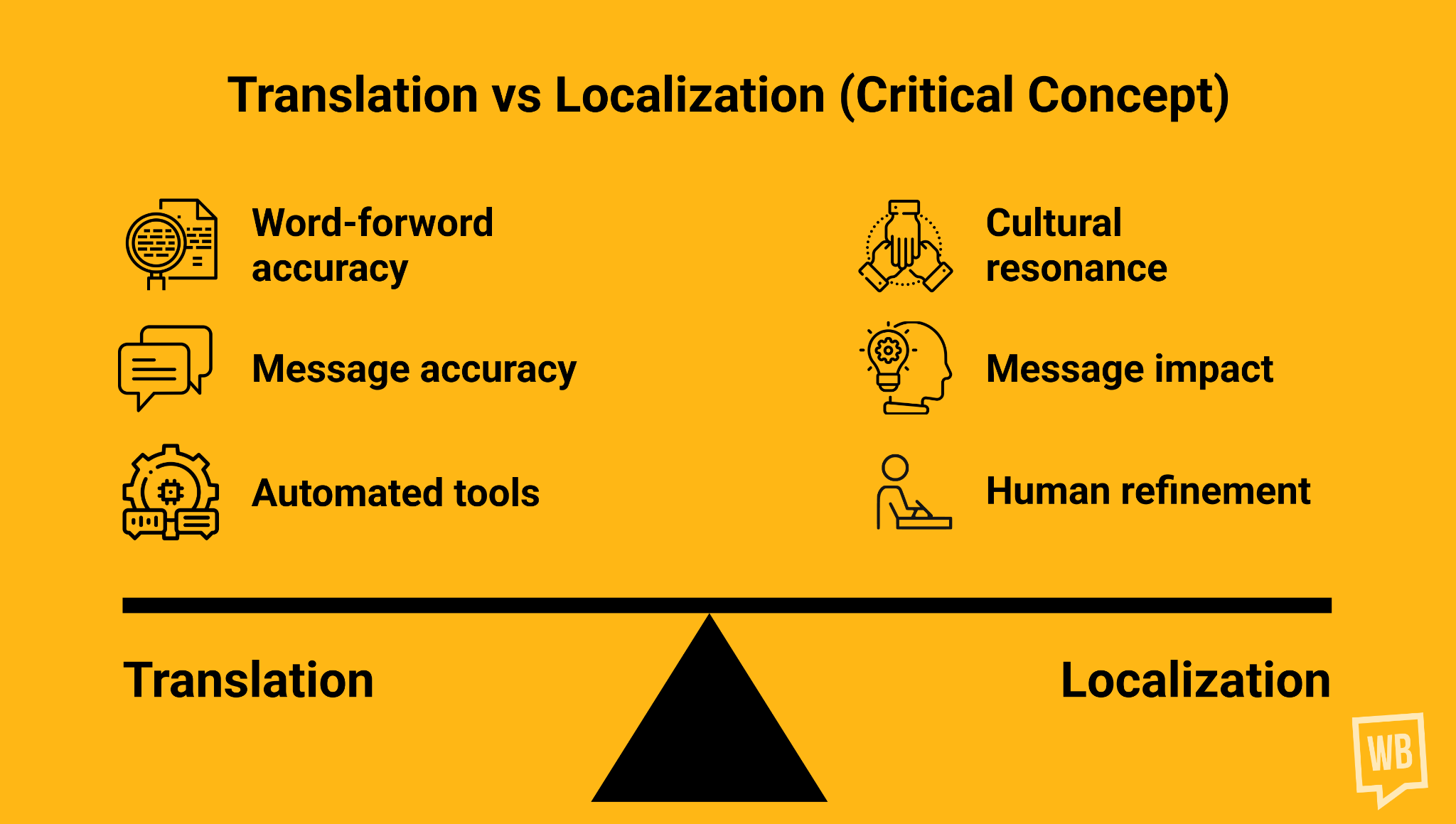
To build an effective strategy, you must understand the difference between translation and localization.
Translation focuses on converting text from one language to another. It ensures that words are accurate, but it does not guarantee that the message will resonate.
Localization goes much deeper. It adapts content to fit the cultural, social, and behavioral expectations of a specific audience.
This includes:
- Language tone and style
- Cultural references
- Visual elements
- Units, currencies, and formats
In many cases, businesses even use a concept called transcreation, which involves rewriting content creatively to preserve its intent rather than its exact wording.
To execute this properly, avoid relying only on automated translation tools. Instead, combine tools like DeepL for base translation and then refine with native writers or editors. You can also build a localization checklist (tone, imagery, CTA style) to standardize quality across markets.
Step-by-Step Guide to Building a Global Content Marketing Strategy
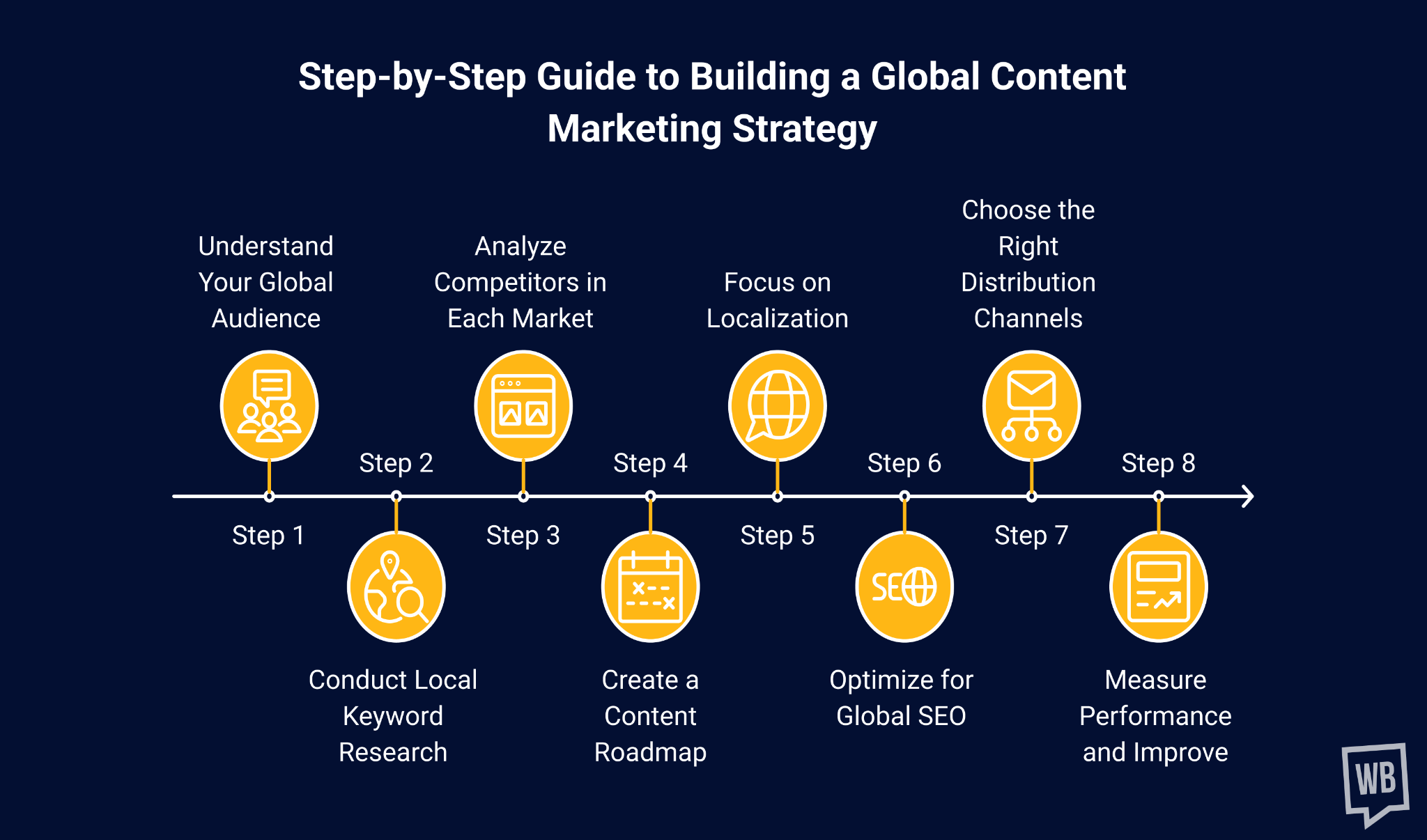
Let’s now break this into a practical, real-world process. Each step connects to the next, so instead of treating them as isolated actions, think of this as a system you build over time.
Step 1: Understand Your Global Audience
Everything starts with your audience. Before you write a single piece of content, you need to understand who you’re speaking to in each region.
At a surface level, this includes location, language, and demographics. But for content marketing to actually work, you need to go deeper into behavior, intent, and decision-making patterns.
For example, a user in Germany might expect detailed, research-backed content before trusting a brand, while a user in India might respond better to value-driven and fast, actionable content. These differences directly affect how your content should be structured.
To do this properly, don’t rely on assumptions; use a combination of data and direct insights.
Start with Google Analytics. Go to audience reports and filter by country. Look at metrics like session duration, bounce rate, and pages per session. This tells you how users from different regions interact with your content.
Then move to Google Search Console. Filter queries by country and analyze what people are searching for. This helps you understand intent, not just behavior.
To validate this data, collect qualitative insights. Run surveys using tools like Typeform or Google Forms. Even a small number of responses can reveal patterns in pain points and expectations.
You can also monitor conversations on platforms like Reddit, LinkedIn, or industry forums to understand how people talk about your niche in different regions.
As you gather this data, organize it into simple audience profiles. Tools like Notion or Google Sheets work well for this. Create columns for country, audience type, key problems, preferred content formats, and primary channels.
This step becomes even more important when you consider whether you're targeting businesses or individual consumers. The way you communicate, the content depth, and even your tone will change significantly.
If you want a deeper understanding of how this impacts your strategy, you can explore B2B vs B2C content marketing because this distinction influences everything from messaging to conversion strategy.
Step 2: Conduct Local Keyword Research
One of the biggest mistakes in global content marketing is assuming that keywords can simply be translated.
In reality, search behavior is deeply influenced by culture, language nuances, and local trends. Even if two regions speak the same language, they may search for the same thing in completely different ways.
That’s why local keyword research is not optional; it’s foundational.
The process starts with identifying a seed keyword related to your product or service. Then, instead of translating it, you analyze how people in each region actually search.
Use tools like Ahrefs, SEMrush, or Ubersuggest. Set the target country and enter your seed keyword. These tools will show variations, search volume, keyword difficulty, and related queries.
But don’t stop there.
Once you have a list of keywords, validate them using Google Search Console. Check if your website is already getting impressions for any of these terms in specific countries. This helps you identify “low-hanging opportunities” where you can improve rankings quickly.
Another powerful method is analyzing “People Also Ask” and autocomplete suggestions in Google for each country. These reflect real user questions and can be turned directly into content topics.
You should also study search intent. Ask yourself:
Is the user looking for information, comparison, or a purchase?
This matters because ranking for the wrong intent will not drive results, even if traffic increases.
Step 3: Analyze Competitors in Each Market
When you enter a new region, your competitors change. And more importantly, the content standards change.
Instead of guessing what works, you can learn directly from competitors who are already performing well in that market.
Start by searching your target keywords in Google for each country. Identify the top-ranking pages and analyze them.
Look at:
- Content length and depth
- Structure and readability
- Type of content (blog, video, landing page)
- Use of visuals and examples
- Internal and external linking
Then go deeper using tools like Ahrefs or SEMrush. Analyze competitor keywords, backlinks, and top-performing pages.
This helps you answer two critical questions:
- What is already working?
- Where are the gaps?
Those gaps are your opportunity.
For example, if competitors are covering a topic but only at a surface level, you can create a more detailed and valuable version. This is exactly how strong content strategies outperform existing players.
Step 4: Create a Content Roadmap
Once your research is complete, the next step is turning insights into a clear plan.
Without a roadmap, content creation becomes inconsistent, and inconsistency leads to weak results.
A good content roadmap connects keywords, topics, formats, and timelines into one system.
Start by grouping your keywords into topic clusters. Each cluster should represent a broader theme related to your business.
Then assign content formats based on intent. For example:
- Informational queries → blog posts
- Comparison queries → guides or case studies
- Transactional queries → landing pages
Use tools like Notion, Trello, or Google Sheets to plan your content calendar. Include columns for topic, keyword, country, format, and publishing date.
You should also align your roadmap with local events and trends. For example, festive seasons, industry events, or regional buying patterns can significantly impact performance.
If you want to strengthen your content creation process itself, this guide on blog writing for business growth can help you structure content that actually drives results.
Step 5: Focus on Localization
Localization is where your strategy truly becomes effective.
This is the step where most businesses either succeed or fail.
Translation converts words. Localization adapts meaning.
To implement localization properly, you need a structured approach.
Start by creating a localization checklist. This should include:
- Tone (formal vs casual)
- Cultural references
- Visual elements
- Currency and units
- Call-to-action style
For example, a direct “Buy Now” CTA might work well in the U.S., but in some markets, a softer approach like “Learn More” or “Get Started” performs better.
Use tools like DeepL or Google Translate for initial drafts, but never rely on them fully. Always refine content with native speakers or professional editors.
For scaling this process, tools like Lokalise or Smartling can help manage translations and maintain consistency.
In some cases, you may need transcreation, where content is rewritten creatively instead of translated. This is especially important for ads, headlines, and emotional messaging.
Step 6: Optimize for Global SEO
Even the best content won’t perform if it’s not discoverable.
Global SEO ensures that your content reaches the right audience in the right region.
One of the most important technical elements here is hreflang tags. These tags tell search engines which version of your page should be shown to users based on their language and location.
To implement this, you can use tools like Screaming Frog or plugins like Yoast SEO (for WordPress).
Next, decide your URL structure:
- Country-specific domains (example.fr)
- Subdomains (fr.example.com)
- Subdirectories (example.com/fr/)
Each has its pros and cons, but subdirectories are often the easiest to manage.
Backlinks are equally important. Focus on building links from local websites, directories, and publications. This increases your authority within that region.
Step 7: Choose the Right Distribution Channels
Creating content is only half the work. Distribution is what actually drives visibility.
Different regions prefer different platforms, so your distribution strategy must be flexible.
Start by identifying where your audience spends time.
In some regions, social media platforms dominate. In others, email or search plays a bigger role.
To figure this out, test multiple channels instead of relying on assumptions.
Run small campaigns using Google Ads or Meta Ads Manager to see where engagement comes from. Use tools like Mailchimp to track email open rates and click-through rates.
Social media platforms like LinkedIn, Instagram, or Twitter (X) can help you build awareness and engagement, while influencer collaborations can help you build trust faster in new markets.
Email marketing plays a critical role in nurturing users over time. Instead of sending random emails, you should guide users through a structured journey.
To understand how to build that journey effectively, you can explore email nurturing campaigns.
When all these channels work together, you create an omnichannel experience. This is why omnichannel strategies retain nearly 89% of customers; they build familiarity through repeated, consistent interactions.
Step 8: Measure Performance and Improve
No strategy works perfectly from the start. Continuous improvement is what drives long-term success.
You need to track performance not just globally, but at a country level.
Start with Google Analytics to measure user behavior, bounce rate, session duration, and conversions.
Then use Google Search Console to track impressions, clicks, and rankings by country.
To go deeper, tools like Hotjar can show how users interact with your pages through heatmaps and recordings.
The key is not just collecting data, but understanding it.
For example, if traffic is high but conversions are low in a specific region, the issue might be messaging or localization. If rankings are low, the issue may be SEO or keyword targeting.
Over time, these insights help you refine your strategy and improve performance consistently.
Common Challenges in Global Content Marketing
Even with a strong strategy, challenges are inevitable.
Cultural differences can make it difficult to create content that resonates with everyone. Language barriers can lead to miscommunication if not handled properly. Limited resources can restrict your ability to scale quickly. And maintaining brand consistency across multiple markets can be challenging.
However, these challenges can be managed with the right approach.
For example, before launching content in a new region, conduct a small test campaign using paid ads or limited content publishing. This helps you validate assumptions without investing heavily. You can also use collaboration tools like Slack to coordinate with local teams or freelancers.
Best Practices for Long-Term Success
To succeed in global content marketing, you need to think long-term. Consistency is essential. Your brand should feel familiar regardless of where it appears.
Data should guide your decisions. Instead of relying on assumptions, use insights to improve your strategy. Authenticity matters more than ever. Studies show that around 88% of consumers prefer brands that feel genuine and relatable.
And perhaps most importantly, you should always be willing to experiment.
One practical way to do this is by running continuous content experiments. Publish variations of headlines, formats, or CTAs and track results over time. Tools like Hotjar can help you understand how users interact with your pages through heatmaps and recordings.
Content Formats That Work Globally
Not all users consume content in the same way.
Some prefer reading detailed articles, while others prefer watching videos or viewing visual summaries.
That’s why using a mix of formats is important.
Blogs are excellent for SEO and in-depth education. Videos are highly engaging and effective for storytelling. Infographics simplify complex information. Case studies build trust by demonstrating real results.
To implement this, repurpose your content instead of creating everything from scratch. For example, turn a blog into a video script, then into social media posts. Tools like Canva can help create visual content quickly and consistently.
Measuring ROI: Turning Strategy Into Results
At the end of the day, your content marketing efforts should drive business growth.
This means you need to measure return on investment.
You should track revenue by region to understand which markets are performing best. You should compare costs with returns to evaluate profitability. And you should assess lead quality to ensure you’re attracting the right audience.
To do this effectively, connect your analytics with CRM tools like HubSpot. This allows you to track the full journey from content interaction to conversion and revenue.
Data-driven companies consistently outperform others, with research showing they are up to six times more likely to be profitable.
Elevate Your Global Content Strategy with Expert Consulting
Take your content marketing beyond basic execution and build a strategy that delivers real global results. With Waseem Bashir’s Content Marketing Consulting Service, you’ll gain expert guidance on everything from strategy and audience targeting to SEO, content creation, and lead generation.
This approach helps you create content that resonates across different markets, improves your search visibility, and turns your content into a consistent growth engine. Instead of guessing what works, you’ll follow proven systems to scale your content marketing with clarity and confidence.
FAQs About Global Content Marketing Strategy
1. How do you prioritize which countries to target first?
Start with markets where you already see traffic, demand, or business potential. Analyze existing data, revenue potential, and competition to prioritize regions with the highest ROI.
2. How much budget is required for global content marketing?
The budget depends on the number of markets, content volume, and localization level. Start small, test performance, and scale investment based on results.
3. How often should you update localized content?
Content should be reviewed regularly based on performance, market trends, and changes in user behavior, typically every 3–6 months.
4. What role does cultural research play in content success?
Cultural research helps avoid misunderstandings, ensures relevance, and allows you to create content that resonates deeply with local audiences.
5. Is it better to create separate websites for each country?
Not always. Many businesses use subdirectories or subdomains to manage content efficiently while still targeting different regions.
Final Thoughts
Global content marketing is not about creating more content; it’s about creating smarter content. It requires a deep understanding of your audience, a thoughtful approach to localization, and a commitment to continuous improvement.
If you focus on these principles, you won’t just reach a global audience, you’ll connect with them. And in today’s competitive digital landscape, connection is what truly drives results.
Related Articles:
Is Content Marketing Dead
How to Create Original Content
Effective B2B Content Distribution Strategies
How Can You Ensure Your Content Drives Action
How to Revitalize Your Content Marketing
Primary Advantage of Generative AI in Content Creation
The Importance of Authoritative Content
How Do You Determine The Authority Of A Piece Of Content
How Content Marketing Drives Sales

